Short answer: Strong final expense calls start with discovery, not rebuttals. Use a short checklist of example themes — budget comfort, beneficiaries, existing coverage, and why now — then ask one clear question at a time. These lines are illustrative training ideas, not a script you must read verbatim. WhisprIQ can surface a next discovery question on your Windows screen during a softphone call; it never speaks to the customer and does not make the call compliant.
Suitability, disclosures, and product recommendations stay yours. Follow carrier, agency, and FMO rules.
Related hubs: Final expense AI sales assistant, Final expense objection handling, AI sales call assistant.
Why discovery gets less ink than objections
Objection posts dominate FE training SERPs — “can’t afford it,” spouse, send-me-info, already-have-coverage. Discovery is quieter on most sites, yet it is what makes those objections easier later. If you never learn who they want to protect, what they already have, or what “affordable” means to them, every rebuttal is a guess.
WhisprIQ’s product language on the homepage includes openers and discovery suggestions for phone agents. This post is the training companion: themes to practice, then optionally keep as on-screen prompts mid-call.
Companion objection deep-dives already live:
- “I can’t afford it”
- “I need to talk to my spouse”
- “Send me info” / “call me back”
- “I already have coverage”
Discovery themes (illustrative checklist)
Ask only what your company process allows. Swap wording for approved talk tracks. One theme at a time — do not interrogate.
1) Budget comfort
Goal: learn a workable monthly range without arguing their bank account.
Illustrative:
“Before we look at options — roughly what monthly amount would feel comfortable for something like this, if it were a fit?”
Or:
“Is there a number you’d want to stay under so this doesn’t squeeze other bills?”
Rules: never invent products or “guaranteed” premiums. Never invent a payment date later when you advance.
2) Beneficiaries / who they want to protect
Goal: connect the policy to their words, not a generic fear pitch.
Illustrative:
“Who were you hoping this would help most if something happened — a spouse, kids, or someone else?”
Or:
“When you think about final expenses, whose plate were you trying to keep that off of?”
3) Existing coverage
Goal: curiosity first — see already-have-coverage guide.
Illustrative:
“Do you already have any life or burial coverage through work or on your own — even a small amount?”
Follow-ups (only if allowed): type, rough face amount, whether it stays if they leave a job, who the beneficiary is.
4) Urgency drivers (“why now”)
Goal: understand timing without manufacturing fake deadlines.
Illustrative:
“What made this feel worth looking at now versus putting it off?”
Or:
“Was there something recent that brought final expenses to mind — or is this more of a check-the-box while you’re free?”
Do not invent “rates go up Friday” or payment-date urgency. If they are ready for a next step, prefer an assumptive advance such as:
“Let’s start the application and see if we can get you approved. Once you’re approved, you can look it over and make any changes if necessary.”
If a spouse / partner should review too:
“Once you’re approved, you can both look it over together…”
5) Health / underwriting path (company-approved only)
Some shops allow light health framing before quoting; others do not. Stay inside your process. Illustrative theme only:
“So I point you at the right type of plan our company offers — are you generally okay answering a few health questions, or do you prefer options that keep that lighter?”
Never promise they will qualify. Never diagnose.
Example micro-flow (illustrative)
Agent: “Before we look at numbers — who were you hoping this would help most?”
Prospect: “My daughter. I don’t want her stuck with a bill.”
Agent: “Got it. Do you already have any coverage through work or on your own?”
Prospect: “Just a little through work.”
Agent: “Okay — and roughly what monthly amount would feel comfortable if we found something that keeps more of that off her plate?”
Then quote only approved options. When they engage on a next step, use your company’s advance (e.g. the application-start line above). If they stall, switch to the matching objection guide — do not stack five discovery questions after they ask to hang up.
Where WhisprIQ helps (and where it does not)
On a Windows softphone / computer-dialer call, WhisprIQ may surface:
- Moment: Discovery / next question
- Strategy: One theme at a time (budget, beneficiary, coverage, why now)
- Action: Illustrative question (you adapt or ignore)
Role-play example (demo UI — not a live customer call):
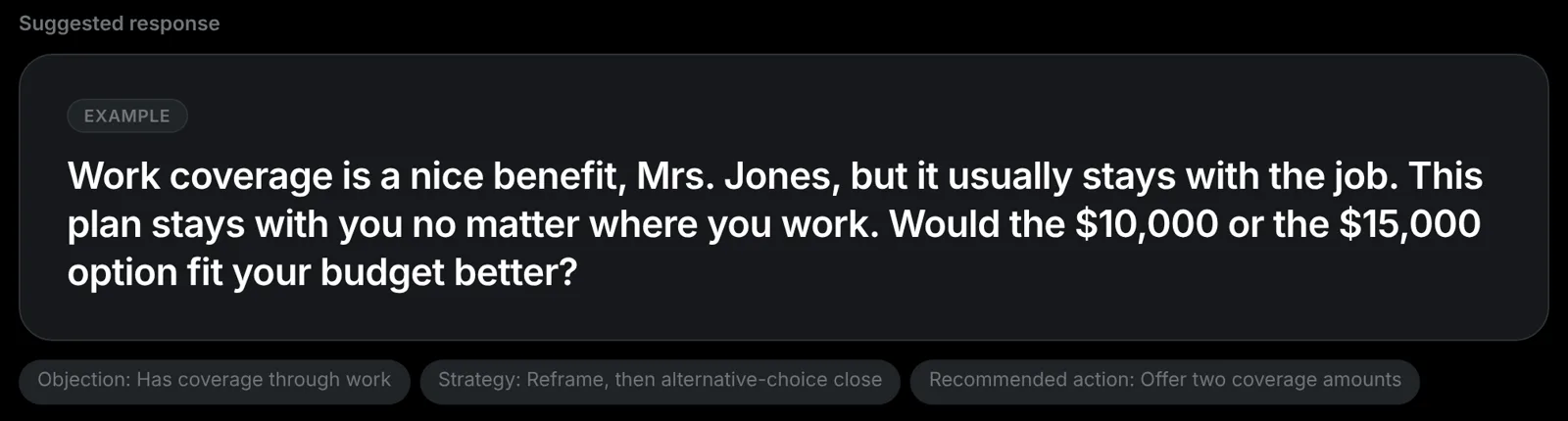
Demo / role-play screenshot from WhisprIQ’s existing marketing library. Illustrative wording; follow your company’s approved scripts. No close-rate or income claims.
WhisprIQ does not: speak to the customer; join as a bot; auto-send email/SMS; decide suitability; guarantee approval; make the call compliant. Pause suggestions anytime.
Softphone truth: works best with a softphone or computer dialer on Windows. Cellphone-on-speaker next to the laptop is a poor fit. Mac = waitlist on /download. More: Softphone vs cellphone.
Soft next step
If your company has cleared AI assist for your role:
- Trial → /signup
- Plans → /pricing (2 free hours or 14 days; card required; Starter / Pro / Power / Teams listed there)
- Windows download → /download
We are not promising higher close rates, income, or revenue — only optional on-screen coaching for discovery moments agents already practice in training.
Disclaimer
Educational training content — not legal, compliance, or product advice. Questions here are illustrative. Follow your carrier, agency, FMO, and state rules. WhisprIQ does not make calls compliant. You own disclosure, consent, suitability, and what you say. Role-play demos are practice only; they are not customer results.
Suggested internal links (wire on publish)
- /final-expense-ai-sales-assistant
- /final-expense-objection-handling
- /ai-sales-call-assistant
- /blog/final-expense-cant-afford-it-objection
- /blog/already-have-coverage-final-expense
- /blog/need-to-talk-to-spouse-objection-insurance
- /blog/send-me-info-call-me-back-objection
- /pricing · /signup · /download
- /whispriq-vs-whisperiq-wispr-flow
Footer one-liner (disambiguation — required)
WhisprIQ (whispriq.com) is a Windows app for real-time phone-sales suggestions. It is not WhisperIQ.dev, Wispr Flow, Whispr, or Whisper transcription.
Word count (body)
Approx. 1,200–1,400 words depending on CMS markup and screenshot caption.